
Security & Compliance
This section is for security reviewers, enterprise partners, and auditors. It describes how Surplus protects data and controls access at a high level.
Each page states what is implemented today and, where relevant, what is on the roadmap — clearly labeled so there's no ambiguity about current state.
Principles
- The app's server is the only door. Browsers and integrators never touch the database, cache, or file storage directly; every call goes through the app's checked API, auth, MCP, or file endpoints. See System architecture.
- Least privilege by role. Every endpoint is gated by role; partner data is scoped to the organizations a user belongs to.
- Secrets stay on the server. Database strings, signing keys, and storage credentials are injected at runtime and never reach clients.
- Defense in depth. Authentication, authorization, rate limiting, CORS, security headers, and input validation each play a part.
- Verifiable, not assumed. Controls are enforced in shared, reviewable code paths.
Trust boundaries
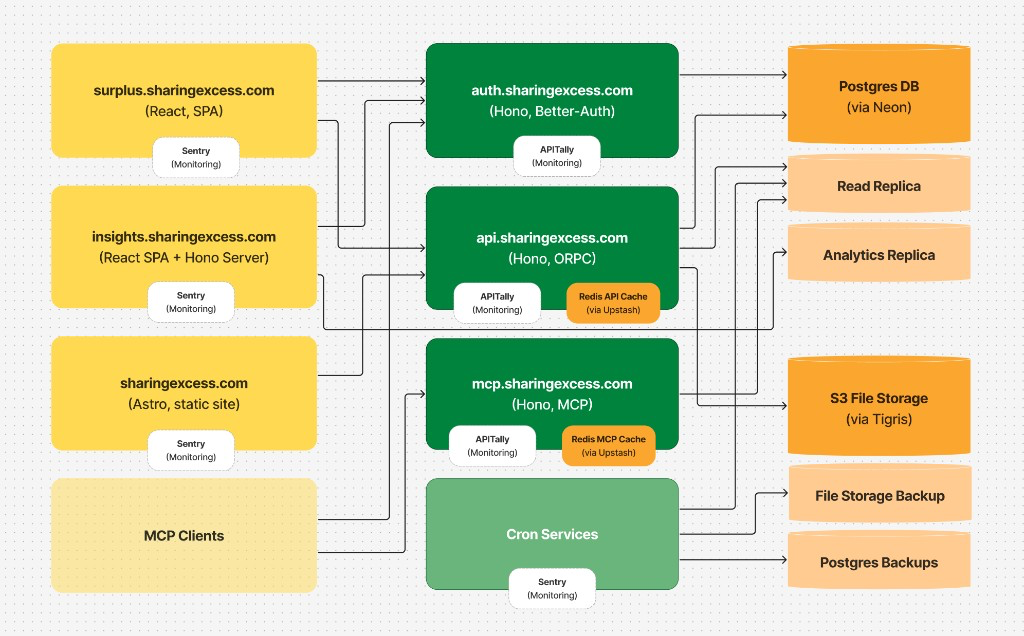
The diagram shows three layers — clients, the Surplus app, and data stores — with monitoring (Sentry on the web app, its server, and every scheduled job) and Redis caches between the app and persistence.
- Web app to its server — signed session token (JWT) in an HttpOnly cookie, on the app's own origin. See Access control.
- Web app to Auth — passwordless email OTP during sign-in.
- MCP client to Auth / MCP — OAuth 2.1 Bearer token (admin and advisor). See MCP integration.
- App to data stores — server-only secrets; primary Postgres for writes, read replica for MCP and crons. See Infrastructure and operations.
- Public surfaces — marketing site and documentation over HTTPS, read-only.
What's covered here
- Access control — sign-in, sessions, roles, and file access
- Data protection — PII handling, encryption, backups, log masking
- Infrastructure and operations — hosting, secrets, network controls, monitoring
- Reporting and supply chain — vulnerability disclosure and dependency management
Scope
These pages describe the Surplus platform: the web app and its server (its API, auth, MCP, and files), data stores, and scheduled jobs. Where a control is partial or planned, it's marked as such.